In the stunning site of Olympia, where they mingle with the calm Alpheus and Kladeos River, the matrix of history gave birth to human ideals of peace and sportsmanship. Here, where athletes competed for prizes with an olive branch and cities—states—were making war truces from 776 BC, the world “… the beautiful, the great, the true.”
Olympia is a milestone and a starting point for all mankind through the ages. Today is the day the hunger of the people grows big, and the equipment Member growing up, the spirit of Olympism can again become the foundation stone for a human society.
It is an area of outstanding natural beauty with flowing waters and abundant vegetation, and of course, in our mythology, Zeus defeated the war of his father, Cronus, for their dominance in the secular world, where he managed to beat him over the hill.
The Olympic Games were held today every four years with a prize of a wreath of wild olive, called a “wreath of wild olive.” The races were held after the summer solstice, the months of July–August, and the first full moon. At first they became one day because it was only six sports; later when sports got 18 days to conduct increased. The games were athletic, equestrian, and later musical. The announcement of racing from town to town was by spondoforous holding branches of olive and carried the message of the sacred truce, which lasted for three months, prohibiting any kind of warfare and capital punishment.
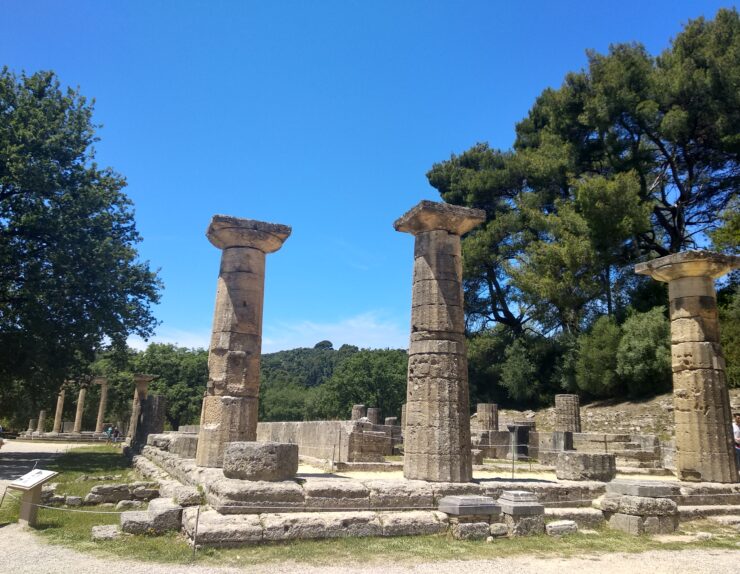
Ancient Olympia Detail of Archaelogical site
All free Greek male citizens were entitled to participate in the games, but they should have committed sacrilege or murder. Slaves and barbarians were not allowed to participate, so later the Romans tried to prove their Greek origin to take part. For women the rules were very strict; the right to participate only had the owners of the horses in the equestrian events. For the rest of the law was so strict that if you violated it, the punishment was death, precipitating Mount Typaio.
The only woman who violated the law and was punished was Kallipateira, daughter of Olympian Diagoras the Rhodian, wife and mother of Olympic medalist Peisirrodou. Kallipateira wanted to attend matches for her son and disguised himself as a trainer to work it out, but the excitement of the mother for her child betrayed ultimately the reason of its origins: the death penalty is not imposed by the judges. Viewers who watched the fights were many and from all over Greece. The athletes had a month to train in Ilia under the supervision of local judges. To comply with the regulations, organizing, conducting sports, and the awarding of prizes were the responsibilities of jurors, an institution that was originally hereditary and lifelong that was later by lot among the inhabitants of Elis.
olimpia4
The 393 by order of the Byzantine emperor Theodosius the games stopped and were forgotten. In 1829, after the liberation of Greece from the Turks, excavations began by French archaeologists, but they stopped when they transferred their findings to the Louvre. The 1875 Excavations resumed in bringing to important light findings.
In 1894 the Frenchman Baron Pierre de Coubertin, who was general secretary of clubs in France and believed that youth around the world has to play sports and not take part in wars. The ideas of those announced at a conference held at the University of Sorbonne and the last day of the conference were the decision to revive the Olympic Games. In 1896 in Athens organized the first modern Olympic Games IOC president Dimitris Vikelas and secretary Pierre de Coubertin. The number of athletes who took part in the games did not exceed 250, but for its time it was the largest sports event and also highly influential in the world.
Today the situation has somewhat improved; the flame is lit in ancient Olympia each time before the Games begin in winter or summer and conveys the message of the Olympic truce worldwide. At the Olympic Games in Athens in 2004, the sport of shot put was the archaeological site with great excitement from spectators and athletes as the ancient stadium opened its gates after centuries to accommodate modern games. The museum of modern Olympic Games, located in ancient Olympia, is unique in the world and is home to memorabilia from modern games.
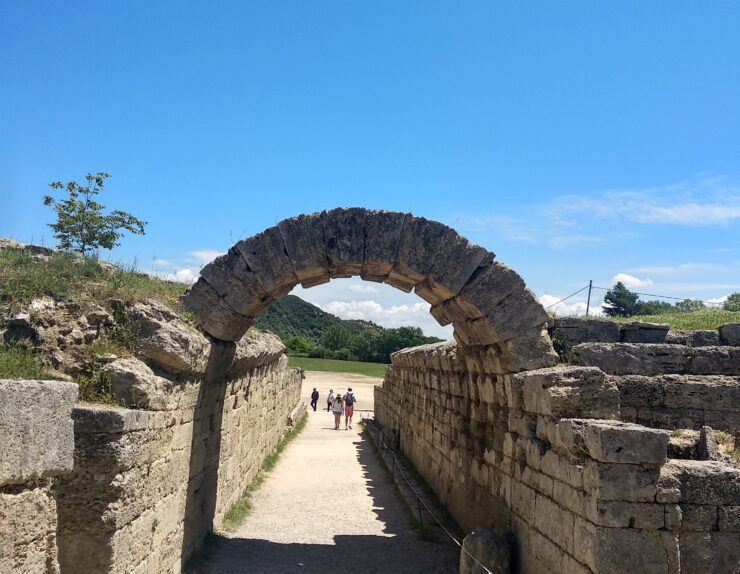
Ancient Olympia Entrance to Stadium
In the western Peloponnese, in the beautiful valley of the river Alpheus, flourished the most celebrated sanctuary of ancient Greece, which was dedicated to the father of the gods, Zeus. Sprawl over the southwest foot of lush Kronios, between the rivers Alpheus and Prunus, which bind to this region. Although secluded near the west coast of the Peloponnese, Olympia became the nationwide most important religious and athletic center. Here was born the biggest race of ancient Greece, the Olympics, which was held every four years in honor of Zeus, an institution with nationwide radiation and glare from antiquity to today. The beginning of worship and mythical confrontations that took place in Olympia lost in the mists of time. Local myths about the ruler of the region, the famous Pelops, and the river god Alpheus, reveal the strong ties between the sanctuary and both the East and the West.
Around the 10th-9th century, the sacred grove began to form, planted with olive trees, pine trees, poplars, and oaks. Then introduced the worship of Zeus and Olympia, from which Zeus was worshipped. For some time in the temple had no other structures except the Altis, which was protected by an enclosure, in which were altars for sacrifices to the gods and the tumulus of Pelops. The numerous votive offerings, mostly figurines, bronze cauldrons, and tripods, were placed outdoors, on trees, and on altars. In the Geometric period date and the first figurines representing Jupiter, the main sanctuary. The 776 AC reorganized in honor of the matches in Ifitos, king of Elis, from Kleosthenes of Pisa and Lycurgus of Sparta, who established a sacred truce. The Olympia was held every four years and soon acquired a national character.
In the Archaic era began the great development of the sanctuary, as shown by the thousands of tributes, period, weapons, statuettes, boilers, and more, and then built the first monumental buildings: the temple of Hera, the Prytaneion, the treasury, and the first stage. The edge of the sanctuary continued in the classic era when it was built, the magnificent temple of Zeus (470-456 BC), baths, porticoes, treasuries, ancillary buildings, and stage moved to the east of the two ancient ones, except the sacred Altis. Numerous were the specials offered by the faithful. The countless statues and other valuable works that existed across the sacred precinct of the Altis were lost, since the sanctuary was looted several times in antiquity, especially in the Roman era. During the Hellenistic period the construction of buildings was mainly secular, like the gymnasium and the palaestra, and in Roman times there were alterations to existing buildings. Also, they built baths, luxury homes, and aqueducts. The sanctuary was plundered so that excellent tributes could decorate Roman villas.
The operation continued normally in early Christian times under Constantine the Great. The 393 AC were the last Olympics, and later the Byzantine emperor Theodosius decreed the permanent banning of the marriage, while Theodosius II came to the final destruction of the temple (426 AC). In the middle of the 5th century AC, up to the already dilapidated buildings, the developed small Christian settlement and workshop of Phidias became a Christian basilica. Two large earthquakes in 522 and 551 AC caused the final destruction of the sanctuary; as long as you then collapsed, buildings were left standing, among them the temple of Zeus. In the following centuries the area was covered by the flooding of the river Alpheus and pruning, and by landslides of Kronios and Olympia passed into oblivion with the ruins covered with backfill. The area was called Echoes, and only 1766 showed the site of the ancient sanctuary.
The first excavations were conducted in 1829 by the French Scientific Mission to the Peloponnese, led by quarterback NJ Maison. Then revealed parts of the Temple of Zeus and parts of the metopes decorated, many of which were transferred to the Louvre Museum. The systematic investigation of the sanctuary began in 1875 with the German Archaeological Institute and continues today. The most recent research in the last decade was in the southwest building, under the direction of Professor of Classical Archaeology at the University of Wurzburg and member of the German Archaeological Institute, Mr. U. Sinn, and prehistoric buildings of the sanctuary, under the direction of Dr. H. Kyrieleis, T., Director of the German Archaeological Institute. Today, alongside the excavation work, there are conservation and restoration projects throughout the site of the ancient sacred site.
The archaeological site of Olympia includes the Temple of Zeus, the churches and buildings directly related to worship, and various buildings that had been built around it, such as sports facilities used for the preparation and hosting of the Olympic Games, utility buildings, and utilitarian and administrative and secular buildings. The Altis, the sacred grove, occupies the central section, and in it grows the core of the sanctuary, the churches.