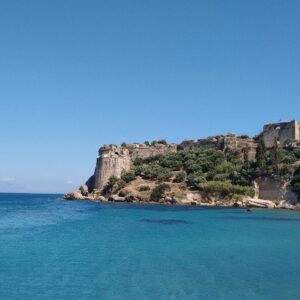
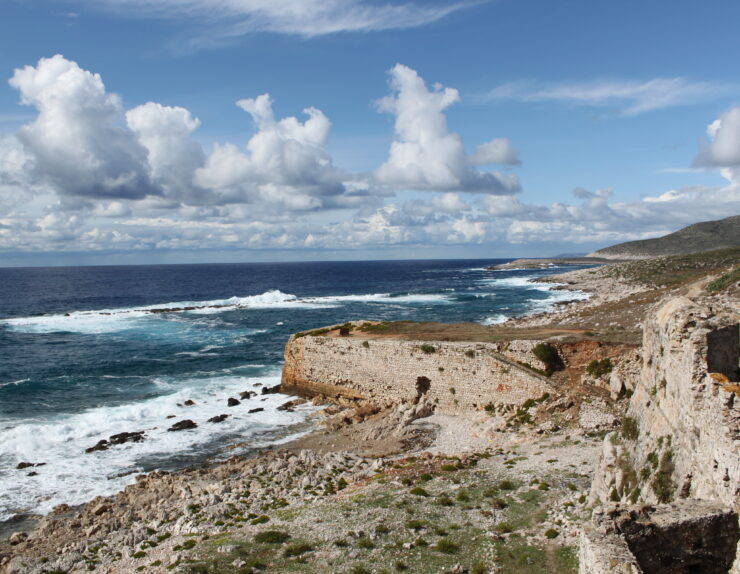
The castle of Methoni is one of the most important sets of Greek fortifications in space. The castle occupies the whole of the southwest coast of the Peloponnese, with an excellent natural harbor, which in medieval times was a station on the road of pilgrims to the Holy Land and cargo ships from West to East. The heyday of the castle is placed in the Venetian period (13th-15th c.)
In antiquity, Methoni was known by the name Pedasos. Homer mentions it as one of the seven cities that Agamemnon offered to Achilles to appease and persuade him to reimburse the battle (Iliad, I, 149-153). Pausanias (Messinian IV, 35, 1) and Strabo (Geography 8, 359-360) called it Mothoni and identified it with the Homeric city. The characteristic is the mention of Thucydides for sick fortified city walls in the 5th century, the form and extent of which remain unknown until today.
Methoni_Castle1
In Roman times the city became autonomous of the Emperor Trajan and enhanced with better fortifications. Pausanias mentions the Temple of Athena Anemotidos and the sanctuary of Artemis, and the city saved coins depicting the harbor. In the early Christian period the port of Methoni flourished as a commercial center and refueling station for ships. During the Middle Byzantine period, a series of stamps dating from the 9th to the 13th century provide us information for government and church services in the city.
The Venetians first appear in the historical scene during the 11th century, when they have privileges on the free movement of goods in various port cities of the Byzantine Empire, including Methoni. With the fall of the Byzantine Empire by the Franks in 1204 (Stafroforia), Methoni will test their dominance. The Frankish period will last until 1206, when Methoni was occupied by the Venetians, and a treaty signed in 1209 ensured their dominance in the city.
During the first period of Venetian life in Methoni organized according to the interests of Venice.
The city was fortified and developed into an important commercial center, defined as an obligatory stop for all Venetian ships traveling to the Eastern Mediterranean. That thriving season for Methoni, ended in August of the year 1500 when, after a bloody siege, it was conquered by the Ottomans. The first period of Ottoman rule would last until 1686, when the city was besieged by Morosini and returned to the possession of the Venetians. In 1715, the Ottomans made the second time holders of Methoni, whose population increased and commercial traffic in the harbor.
During the Greek Revolution the castle of Methoni was not captured by the Greek rebels, despite repeated efforts, due to the resistance of the fortified Ottoman population. In 1825 he landed in the port city of Ibrahim and settled inside the castle, which became the base of operations for Egyptians during their campaign in the Peloponnese. The Egyptians would surrender without a fight in 1828 at the French expeditionary force led by General Maison. The settlement was then transported outside the walls, and the street plan of the city and the castle that for centuries was the center of social and economic life of the town is deserted.
The harbor and the castle of Methoni have for centuries been important geopolitical hubs for their respective holders, for economic trade and transportation for the travelers in the Mediterranean, and for the pilgrims to the Holy Land.
Methoni_Castle
The Castle of Methoni—area of about 93 acres—consists of two parts. To the south lies the city, surrounded by simple walls with towers at regular intervals, while the northern part, which is reinforced defensively as it is the most vulnerable, developed the town’s fortress, home of the occasional military commander. The two sections are separated by an intermediate low wall reinforced with five towers.
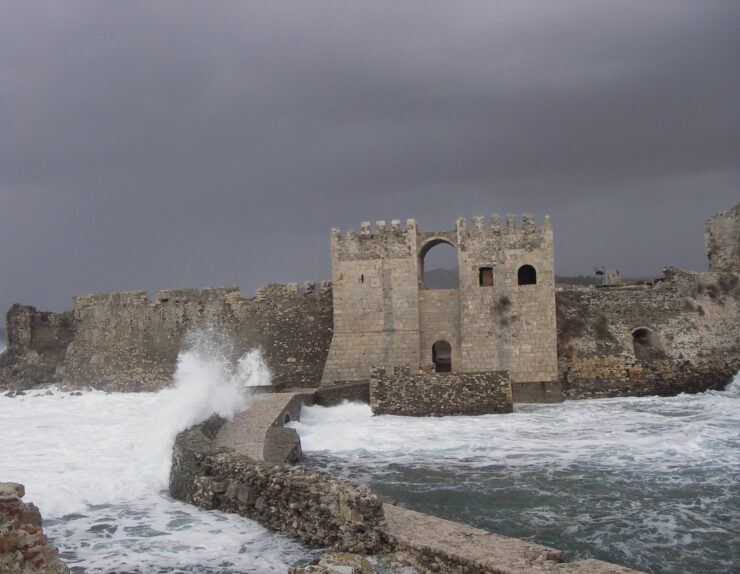
The walls of the fortress are protected by a wide moat and supported by two ramparts that dominate the north side of the castle. In the middle of the same side, the main entrance gate is made of rectangular ashlar limestone and has elaborate decoration of the pilasters. The castle has six more gates, three of which are on the harbor side. Most of the doors opened on the ground floor tower and were protected by katafrages and gun loops.
The castle walls made of rough-hewn stones with strong bonding plaster have battlements, which are accessible from the devil which is accessible from inside the two parts of the castle. The walls were reinforced at intervals with towers, most of which are preserved at very low altitude. Depending on your needs and the development of military architecture to address the new requirements of the martial art, the walls were reinforced or rebuilt.
Within the castle were kept various structures. In the central part, known as the “Square of Weapons,” is the I.V. Transfiguration, a single-spaced wooden roofed temple probably built during the Venetian period.
The vicinity of and in contact with the western wall is a small square building with a pyramidal cover, which is used as a gunpowder and dates to the first Venetian period. Along the main corridor of the castle survived two Ottoman baths consisting of several vaulted rooms, each of which had different uses (locker room, lukewarm room, and warm room). Dating back to the first period of Ottoman rule. Nearby is maintained the base of the minaret of a mosque damaged now. The mosque was built on the site of a basilica, the exterior walls of which were reinforced with buttresses. Perhaps it is the church of St. John the Theologian.
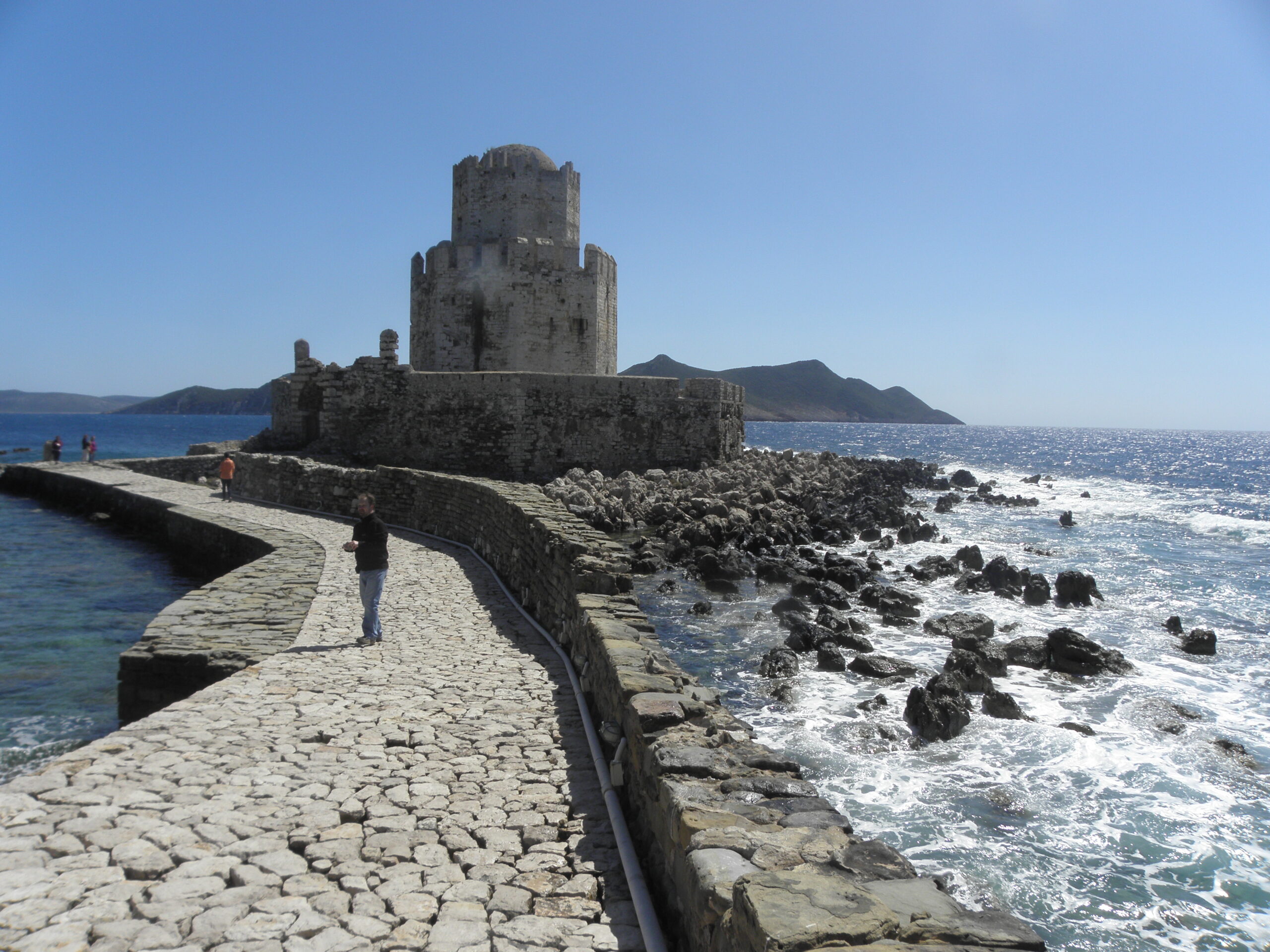
The architectural feature of Methoni is Mpourtzi, an over the sea small fort, built on a small island in the south of the castle. Consists of an octagonal tower, which is surrounded by a low octagonal wall. The tower is built on two levels and is covered with a semicircular dome. The ground floor occupies a quadrangular cistern. The ramp leads to both transepts of the perimeter wall and the upper floor of the tower, which formed a room with a cannon around it. The interior walls are distinguished by beam cases relying on four wooden floors, now destroyed. The construction of the fort began shortly before 1500 by the Venetians and completed by the Ottomans in the 16th century.
Mpoyrtzi was part of the maritime fortress of Methoni and served several purposes through time: it was used as the headquarters of the garrison to control the port, and as a beacon, jail, and shelter for residents in times of siege.
Most evidence for the castle of Methoni is mainly from travelers and pilgrims using the port as a necessary sea hub on their journeys, recording their impressions, and painters and cartographers who thought to portray the castle, offering valuable
Methoni (Messinia Prefecture) Tel.: +30 27230 31255